
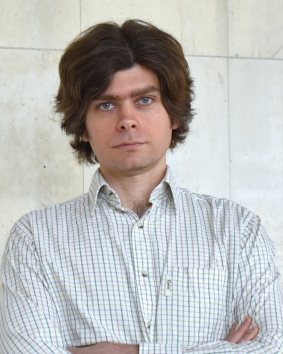
Anatolii Spesyvyi studied nanoelectronics at Sumy State University in Ukraine and, in 2016, obtained his PhD from the Faculty of Mathematics and Physics at Charles University in Prague in the field of plasma physics and ionized environments. Since 2012, he has worked at the J. Heyrovský Institute of Physical Chemistry of the Czech Academy of Sciences, where he studied ion–molecule reactions using mass spectrometry and their application in new methods for analyzing trace substances in air (Selected Ion Flow–Drift Tube Mass Spectrometry).
Since 2020, he has been responsible for the development and construction of the SELINA (Selected Ice Nanoparticle Accelerator) apparatus within a joint project with the Leibniz Institute of Surface Engineering (IOM) and Leipzig University. This instrument is designed to produce size-selected ice nanoparticles (50–1000 nm) to mimic space dust in the vicinity of Saturn’s moon Enceladus and to test novel space-probe mass spectrometers. A wide range of innovative techniques has been incorporated into SELINA, including electrospray, a hydrodynamic atmospheric-pressure interface, charge detection, time-of-flight analysis, frequency-controlled quadrupoles, electrostatic acceleration, and surface-induced dissociation. This unique combination has also proven to be highly useful for the analysis of biological nanoparticles, specifically membranous vesicles.
Dr. Spesyvyi worked at Leipzig University in 2025 as a research assistant in the team of Prof. B. Abel on the project “BISON – Biohybrid solar power plant for converting light into chemical energy – sustainable, efficient, resource-saving,” where he was responsible for the design of an electrochemical anode surface modification setup. Since 2026, Dr. Spesyvyi has held the position of researcher at the SPACE ERA CHAIR, where he develops new techniques for the production of space-dust-analogue nanoparticles and their compositional analysis using mass spectrometry.